Showing posts with label Finance 101. Show all posts

Saturday, June 6, 2020

Finance 101: What is a Stock Market/ Stock Market Index /Stock Exchange?

Hi friends,

Today's topic is submitted by one of you guys. Do continue with asking me to explain such terms that I have used in my posts without thinking of people with 0 financial knowledge. I will write a post on it if the question has a large-enough scope for me to write a post. 

So, what is the Stock Market/ Stock Market Index? Or even, what is the Stock Exchange? Do note that they are very different things. Allow me to start with the easy one first: 

What is the Stock Market?
We have often heard the news tell us that "The stock market crashed today/ it rallied today". In those cases, the word  "stock market" actually refers to an overview of all the public-traded companies in that country. 

Hence, it is kinda contextual. If you receive the news from CNN, and they are referring to the stock market, they would be referring to the US stock market. 

What is the Stock Market Index?
Here are some examples of Stock Market Indexes - S&P 500, Dow Jones Industrial Index. STI. These indexes serve as a measurement of that component of the stock market (Large-capped, small-capped). Just like how S&P 500 allows us to measure the Large-Cap segment of the stock market.  There is a total stock market index that measures the entire US stock market. ETFs are then funds that follow these indexes. 

What is the Stock Exchange?
It is a secondary market where financial instruments (Such as stocks, bonds, derivatives, currencies, and commodities) are traded between sellers and buyers (An exchange's job is to match the sellers to the buyers and vice versa). 

New stocks can also be listed on the exchange through an IPO and gain access to more capital from investors. A lot of exchanges will also require a certain standard of the company before allowing them to be listed on their exchange. 

Here are some examples of famous stock exchanges around the world:
1. New York Stock Exchange (NYSE) - US$23 Trillion in the listed market cap
2. National Association of Securities Dealers Automated Quotation (NASDAQ) - US$11 Trillion
3. London Stock Exchange (LSE) - US$4 Trillion
4. Hong Kong Exchanges and Clearing - US$4 Trillion (Usually for access to the Chinese market, or you can use the next one as well)
5. Shanghai Stock Exchange - US$4 Trillion

All these exchanges can have their own indexes to measure their own stock market (LSE has the FTSE 100, which measures the 100 biggest companies listed on their exchange). These exchanges also form to be a network whereby large sums of money are moved on a daily basis.

Nowadays, if you wish to buy/sell stocks, you do not need to call anyone on the stock exchange. You can buy using some platforms that will help you do the transaction. Furthermore, we can look at stock prices whenever we feel like nowadays due to the advent of our smartphones Hence, these conveniences will allow for better efficiency in investing. 

With that, 
I end today's topic. 

Stay vested, Stay frugal my friends,

Dionysius

Saturday, May 23, 2020

Finance 101: What is a portfolio?

Hi friends, 

I bet that you have heard of it before. "I have a portfolio of blah blah blah", or "How big is your portfolio?" So... What is this "portfolio" that everyone who is investing/ planning their finances is talking about? Today I shall be tackling this question:

Definition:
A portfolio is a grouping of financial assets such as stocks, bonds, commodities, currencies and cash equivalents, as well as their fund counterparts, including mutual, exchange-traded and closed funds. A portfolio can also consist of non-publicly tradable securities, like real estate, art, and private investments. - Investopedia

A portfolio refers to a collection of investments or financial assets held by an individual, investment company, financial institution or hedge fund. This grouping of financial assets can include everything from gold and property to stocks, bonds, and cash equivalents. In essence, an investment portfolio acts as a big briefcase-carrying all of these financial assets. - Capital

These are the essential points.

1. Group of financial assets (Financial instruments that can be anything that we discussed and more, like real estates, arts, whiskey, etc)

2. Held by an individual, company, funds. 


For today, we will be talking about your individual portfolio. As per the definition, your portfolio is a combination of the different financial instruments that you are holding. A portfolio is also something that you should build based on your preferences. It should be in line with your investment beliefs and your risk appetite

Here are some of the things you should consider before setting off to build your portfolio:

1. What is your risk tolerance? 
How much gain/loss are you able to tolerate? Are you ok with a portfolio that can give you large returns and losses?

2. What is your time horizon?
A longer time horizon would mean that you can create a portfolio that has a higher potential for appreciations. 

3. What assets are you comfortable/ familiar with?
If you are competent and have a lot of experience with a particular financial instrument, you can consider having more of your portfolio allocation to the instrument that you are familiar with. 

Here are some of the financial instruments that you can have in your portfolio. We have actually gone through the majority of them in the other Finance 101 articles:

1. Stocks, etfs, mutual funds, index funds, Reits 
2. Bonds, bond funds
3. Gold, precious metals
4. Crypto (Bitcoin, ethereum)
5. Real estates 
6. Other financial instruments like alcohol, art, etc
7. Commodities like copper, steel, oil
8. Insurance

As we are talking about the personal portfolio, in which I would assume that you do not have the need to invest in commodities, alcohol, art etc. We will focus on 1,2,3,4,5,8 I will analyse it from the POV of a) Aggressive investors (with a long time horizon) b) Conservative investor (with a shorter time horizon) c) Investor who is looking to pass intergenerational wealth d) ultra-aggressive investor

Do note that the allocations are just for example. You should do your own research. 

a) Aggressive Investor (For those who wants :
1. Stocks (85% in etf, individual stocks)
2. Bonds (0%)
3. Precious metals (4% in gold)
4. Crypto (1%, treat it as a gamble)
5. Real Estates (5%)
8. Insurance (5%, to protect against sudden events)

b) Conservative Investor (For those who wants to have some returns but cannot take too many losses)
1. Stocks (20% in etfs, and reits etfs)
2. bonds (60% in bond funds)
3. Precious metals (5% in gold)
4. Crypto (0%)
5. Real Estates (5%)
8. Insurance (10%)

c) Generational Wealth Investors (For those who wishes to pass to their offsprings without incurring taxes)

We do not have inheritance tax in Singapore. But do know that if you pass on properties, your offsprings might need to pay property taxes on it, or pay for the maintenance fees. 

Hence, you might want to consider holding on to stocks and bonds. 

d) Ultra-aggressive Investors (me, with about 30-40 years of investing)
1. Stocks (95% in etf, individual stocks/ reits)
2. Bonds (0%)
3. Precious metals (0%)
4. Crypto (0%)
5. Real Estates 
(0%)
8. Insurance (5%, to protect against sudden events)

I will reiterate this again. Your portfolio would be reflective of your investment beliefs. Your portfolio should be tailored to your needs. Of course, with a portfolio, you should always look at it every now and then to rebalance it. The rebalancing would allow your portfolio realigned with your chosen allocations. This rebalancing should be around once per 3 months. 

As always, do take note that the allocations are just examples, you should always do your own research before making any financial decisions. 

Also, now that we have settled a majority of the financial instruments, I will be moving on to the most famous financial portfolios that are held by famous investors like Warren Buffett, Ray Dalios, etc. It will be named "Finance 201". I am an Engineer for goodness sake. How creative do you think I am :')  Don't worry. Finance 101 series will still run on, just keep sending in request so that I know to explain some of the basic terms that I have used in my posts

With that, 
I end today's topic

Stay vested, Stay frugal my friends,
Dionysius


Wednesday, May 20, 2020

Finance 101: What is a Bond?

Hi friends, 

Bond, James Bond


Up to this point, I hope that you have benefitted from this series. 
I have also benefitted from the series as I learned about infographics design for this series and reinforced my financial knowledge as well. Do let me know if you have any ideas for Finance 101 or any other series that I can do. 

With that out of the way, let's look at the financial instrument that allows you to be a loan shark - Bonds. So, what is a bond? 


Definition:

A bond is a fixed income instrument that represents a loan made by an investor to a borrower (typically corporate or governmental). A bond could be thought of as an I.O.U. between the lender and borrower that includes the details of the loan and its payments. - Investopedia

Bonds are debt instruments. When you buy a bond, you are lending money to the company or government institution issuing the bond for a fixed rate of return. -DBS


The keywords are:

1. Loan/debt
2. From company/government to investor
3. Fixed-rate of return

Essentially, you are lending a sum of money to a company or government, in which you will receive interests annually for the period and you will receive the sum of money that you lent at the end of the period. The entity that issued the bonds would use the money and invest in projects/infrastructures that they believe will have a better return compared to the interest they pay you. (i.e, I borrow $5,000 at 1% interest, to invest for a return of 8%. Profit for me 7%)


Furthermore, in the event where the entity is unable to pay its debt (default), bondholders have higher priority over stockholders over the liquidated asset of that company. When the company makes money, bondholders are also prioritised over stockholders in receiving the money. 


"That's great! Why does everyone not rush to bonds?" Good question, that's because historically, bonds have an average return of 5% but stocks have an average return of 10%. Furthermore, low risk doesn't mean no risk. There are cases where companies or countries that have defaulted on their loans (Does the name Hyflux ring a bell?).


Hence, bonds as a financial instrument would be suited for a conservative investment approach. This is the reason why we are recommended to allocate more of our portfolio to bonds as we age. Furthermore, bonds are income-generating assets rather than growth assets. Hence, if your desire is to have passive income, you may look at bonds as a valid option. 


BUT, if you would refer to my 4% Rule article, you would know that bonds are unable to last you that long into retirement based on historical data. Furthermore, Warran Buffett has not incorporated bonds into his portfolio at his age as well. So you might want to take that into consideration. 


After this long period of voicing my opinion, let's look at the advantages and disadvantages of owning bonds. 


Advantages: 

1. Safe and consistent income - due to the interest rate (coupon) that you will receive
2. Higher on the priority list in the event of liquidation
3. Passive income 
4. Diversify your portfolio as it is a different financial product from stocks

Disadvantages:

1. Lower returns as well
2. Default is still probable
3. Some bonds are not available to retail investors (Some bonds are too high in value, $250,000 for one bond)

These are the priority of bonds payout (A higher priority would mean that you would be paid first in the event of liquidation) 

1. Senior secured bonds (secured means that that debt is backed with collateral)
2. Senior unsecured bonds 
3. Junior Subordinated bonds
4. Guaranteed and insured bonds (The guaranty is from a third-party, but not 100% insured.)
5. Convertible bonds (Can be converted to common stock)

How to find the right bond?
1. Coupon Rate: It is the interest rate paid on the bond (3% of $1000 would be $30)
2. The seniority of the bond: If you have higher priority if the company is liquidated
3. Outlook of the company: If the company is over-leveraged on debt, income statement etc. 
4. Inflation trend: If inflation is at 3% and your bond has an interest rate of 3%, your effective return is 0
5. Liquidity of the bond: If you require money in a short amount of time, are you able to redeem the bond for cash? You can look at the daily trading volume of that bond. 

Thoughts and comments:
As bonds are currently not in my portfolio, I am not that familiar. However, if you wish to diversify your risk, you might want to consider using bond ETFs which has a lower chance of losing your money. 


Sources:

https://www.investopedia.com/terms/b/bond.asp
https://www.dbs.com.sg/personal/investments/fixed-income/understanding-bonds
https://www.investopedia.com/articles/investing/121815/understand-security-types-corporate-bonds.asp
https://www.investopedia.com/articles/bonds/09/bear-on-bonds.asp
https://www.investopedia.com/articles/bonds/07/fixedincome.asp

Wednesday, May 13, 2020

Finance 101: What is a Real Estate

Hi friends, 

Today I will be writing about something that is on a lot of our minds in Singapore. Similar to REITs, just that it is something on a personal level and not managed by anyone. It is real estate. 

So...... just some fun facts:
1. Almost half of Singaporeans (2.18 million out of 5 million) are in the world's richest 10%, 226,000 (5%) people are in the 1%
2. For the year 2019, the average Singaporean has US$300,000 in their name, with US$150,000 in real estates
3. The median has about US$100,000. 

As you can already infer, with our small land-size, if we were to include the house that we are living in into our asset calculations, a lot of Singaporeans would be classified as rich on a global standard. The average price of private property in the city is US$874,372. The average of public housing (3-rooms) is around US$200,000. Hence, it would be correct if I were to say that majority of our wealth is locked up in properties. 

But, I would say something that goes against what you believe in. You can only treat something as an asset if it brings you income (by increasing in value and you selling it or by renting it out). Hence, if you are not going to sell/rent the house that you are currently staying in, it is not an asset. That is your personal property.

For subsequent parts of this post, I will be treating real estate/properties as an asset, that means, you are renting it away or planning to sell it. These can be commercial properties (like those shop units that you can rent/sell to shops/offices) or residential properties (those that you rent out to tenants or sell) or industrial properties (warehouses, factories)

So.. What is a real estate?
Investment real estate is real estate that generates income or is otherwise intended for investment purposes rather than as a primary residence. It is common for investors to own multiple pieces of real estate, one of which serves as a primary residence while the others are used to generate rental income and profits through price appreciation. - Investopedia

So essentially:
1. Real Estate is an investment only if you are selling it or to rent it out 
2. If you are using it for residential purposes, it is not an investment.

So now that we know what a real estate is, let us take a look at the advantages and disadvantages of it and compare it to REITs as well:

Advantages of owning real estates:
1. Leverage (Purchasing a Real Estate would often mean that you can borrow money from the bank. For example, a property is valued at $1,000,000, you would just need to pay the downpayment of 10% to own it.)
2. Stability (This is especially evident in Singapore. Due to our small size and relatively dense populations, it would be safe to assume that there will always be a demand for housing. Hence, the prices of properties in Singapore have been steadily increasing. Even for public-housings)
3. Cashflow (Imagine just sitting there and receiving rent payment from your tenants. Quick passive income)
4. Diversification (Historically, real estates have shown to be negatively correlated to other financial instruments)

Disadvantages of owning real estates:
1. Taxes and transactions cost (Property taxes, stamp duties, income taxes from rents, ABSD)
2. Liquidity (It takes a while for properties to be liquidated. This is especially significant if you require money in a short span of time.)
3. Tenants and ongoing expenses (People that you rent to may default on their rents due, plus you are responsible for the maintenance cost of the property)
4. Fluctuations in market (Economic conditions would affect the market demands and hence prices of your properties)
5. High entry barrier  (You can't buy Real Estate with a $1000 capital, but you can buy other financial instruments with that sum of money) 

Now you would question: Wow, Real Estates sounds like REITs. So let's compare the two of them. 

Real Estates better than REITs:
1. You make your own decisions on where or what properties to invest (REITs decide on what properties to invest in)
2. Higher leverage compared to REITs (In Singapore, REITs are only able to have a leverage ratio of 50%)
3. Better cashflow (You receive rent every month, rather than the quarterly dividends paid by REITs
4. No management fees (You have to pay for the professional management of the properties)

REITs better than Real Estates:
1. Better liquidity (REITs are traded on stock exchanges, hence, liquidation is within a day)
2. More diversification (REITs normally owns more than one property. This higher number of holdings would mean a better diversification.)
3. Lower barrier to entry (REITs cost lesser than Real Estates to own)
4. Professional management (There are people managing the properties for you)

Criteria to look for in a good real estate:
1. Location (This is important if you wish to rent out your properties)
2. The future prospects of the property area (Are there going to be amenities, malls, business development, that are going to build in that area? If you can foresee that the area has a high demand in the future, it has high appreciation potential)
3. Timing (This is important for properties, as property prices are still tied to economic conditions)

Thoughts and comments:
I believe that Real Estates do play a significant portion in our financial portfolio. Especially in Singapore where we have such a small land supply. However, due to the high barrier of entry and the property taxes, I am unable to afford them in my portfolio at the moment. I believe that as I get old and want a conservative approach to my investments, I would move more portions of my portfolio to real estate.  

Personal Portfolio:
$0 in real estates

With that, 
I end today's topic. 

Stay vested, Stay frugal my friends,
Dionysius


Sources:
https://www.statista.com/statistics/785044/singapore-number-of-millionaires/
https://www.businessinsider.sg/half-of-singapore-is-in-the-worlds-richest-10-and-226000-people-are-among-the-elite-1
https://www.todayonline.com/singapore/singapore-worlds-second-most-expensive-housing-market-cbre-report
https://www.hdb.gov.sg/cs/infoweb/residential/buying-a-flat/resale/resale-statistics#pdurrentresalestatsmedianresalepricesforregisteredresaleapplications13838002997481
https://www.investopedia.com/terms/r/realestate.asp
https://www.investopedia.com/articles/investing/072314/investing-real-estate-versus-reits.asp

Saturday, May 9, 2020

Finance 101: What is a Cryptocurrency?

Hi friends, 

Today I will be talking about something similar to Gold or "Digital Gold"  - Cryptocurrency. 

So... What is a cryptocurrency?

A cryptocurrency is a digital or virtual currency that is secured by cryptography, which makes it nearly impossible to counterfeit or double-spend. Many cryptocurrencies are decentralized networks based on blockchain technology - Investopedia 

Cryptocurrency is an internet-based medium of exchange which uses cryptographical functions to conduct financial transactions. Cryptocurrencies leverage blockchain technology to gain decentralization, transparency, and immutability. - Blockgeeks

Here are the keywords:

1. Digital/ virtual currency 

The concept and implementation of digital currency began in the 1990s, with Flooz, Beenz, Digicash. The transactions were not peer-to-peer (P2P), stored in a centralised data-based. They did not receive the same exposure and success as cryptocurrencies. 

2. Cryptographical functions

Cryptography means to take in a set of values, run them through a set of algorithms to produce something that does not look at the original input. Being encrypted would mean that the data would be "protected"

3. Decentralised

As cryptocurrencies' transactions are stored and recorded by each user, there is no central authority that stores it. Furthermore, some of the currencies like bitcoin has a fixed supply (21 million), hence, this property would be similar to precious metals like Gold. Hence, it is not affected by the monetary policies of financial institutions.

So... what is a cryptocurrency?
Erm... Effectively, think of it as online Gold, where it is almost impossible for people to hack into the database. All the transactions are recorded by other computers. 

How does it work?

Imagine someone wants to send a sum of money to his friend (can be a merchant as well). He would use his private key to sign the "transaction" and send it. Upon sending, this "transaction" will be broadcasted to the network and be recorded by all the users in the network.  

Edit (My friend who was a lot more knowledgeable helped me with this): 
Imagine someone wants to send a sum of money to his friend (can be a merchant as well). He will first have to create a "wallet"(also used as an address), which is essentially a private key public key pair (private key creates public key) He would use his private key to sign the "transaction" and send it together with the public key. Upon sending, this "transaction" will be broadcasted to the network and be recorded by all the nodes (miners) in the network.

After that, miners would confirm the transaction and spread them in the network. After the confirmation, every user has to add it to their database. This would then be a part of the blockchain. (Essentially, the blockchain is a series of transactions that has been confirmed and you can no longer change it)

Edit (My friend who was a lot more knowledgeable helped me with this): 
After that, miners (essentially solving an incrementally computational-intensive puzzle. The first miner to solve it first will get to chain the block to the existing chain and earn the reward ) would confirm the transaction (by order of transaction fees) and add them to a block* in the network which is broadcasted to the entire network. This would then be a part of the blockchain. (Essentially, the blockchain is a series of blocks containing transactions linked together by the hash of the parent block )

So.. What is a miner?
I do not fully understand this. Let me try to explain the concept to the best of my abilities. A miner's job is to find a hash, something generated from the cryptographic process which connects the new block to the previous block. Upon finding it, he confirms the transaction, adding it to the blockchain and he receives a set amount of it. This is a finance blog. So I shall focus on the financial aspects. 

Here are some of the interesting statistics that I discovered:
1. In Dec 2019, the Market Cap of all Cryptocurrencies was $237.1 billion. (In 2013, it was 10.62 billion) 
2. Bitcoin (The first cryptocurrency) accounts for $6 billion of the daily transaction (VISA has $30.3 billion, MasterCard has $16.2 billion, Amex has $3.2 billion)

Advantages of Cryptocurrencies:
1. Security and privacy (Blockchains cannot be hacked)
2. Low transaction fees 
3. Portability (compared to physical precious metals)
4. An increasing rate of adoption 
5. Not subjected to monetary policies changes (Unlike other physical currencies)
6. A high rate of returns

Disadvantages of Cryptocurrencies:
1. Some countries have outlawed cryptocurrencies (Due to the potential of illegal transactions like terrorist fundings or money laundering)
2. Volatility (This is unlike Gold, which has a relatively stable price)
3. You lose everything if you lose your private key 
4. Speculative, blockchain's values are not determined yet. 

How to choose a cryptocurrency to invest in:
1. Your risk appetite - Do you want to invest in one that is new or relatively more established?
2. Future outlook of the currency - Do you see the wide adoption of that particular cryptocurrency? 
3. USP of the currency - What sets that particular currency apart from other cryptocurrencies?
4. Are you willing to lose that money? 

Thoughts and comments:
As cryptocurrencies by itself are like Gold. Its price is speculative in nature. It is unlike stocks of companies that bring values to the market. Furthermore, its volatility is not suitable for my fragile heart. If I have additional cash on hands in the future, a portion of it would be inside as part of my "gamble" hopefully it will pay off. 

Do your own research before buying any products. 

With that, 

Stay vested, stay frugal my friends,
Dionysius


Sources:
Nicholas Chia 
https://blockgeeks.com/guides/what-is-cryptocurrency/
https://cointelegraph.com/bitcoin-for-beginners/what-are-cryptocurrencies
https://www.investopedia.com/terms/c/cryptocurrency.asp
https://leftronic.com/cryptocurrency-statistics/
https://www.flaticon.com/authors/freepik
http://www.onlinewebfonts.com/icon
https://www.statista.com/statistics/647374/worldwide-blockchain-wallet-users/
http://www.onlinewebfonts.com/icon

https://www.coinwarz.com/mining/bitcoin/difficulty-chart

Wednesday, May 6, 2020

Finance 101: What is Gold?


Hi friend,

Today I shall be looking at Gold as a financial instrument. From ancient times, Gold has been an extremely sought-after object, from the ancient Egyptians to wall street investors. Gold has always been perceived as a form of luxury and riches. Even though Gold has few practical usages outside of industrial applications, and there are metals that are rarer than Gold on Earth, Gold is the highest-priced rare metal.

This concept of Gold having a high perceived value is important to us. As it would mean that Gold has value because we believe that it has value collectively. With that understanding, let us move onto the definitions:

Gold is often looked at as a store of value, but it's also a highly speculative asset linked to currencies and interest rates. - Investopedia

Erm... This is the first time where Investopedia's answer is not comprehensive. 

Allow me to explain the Unique-Selling-Point (USP) of Gold:
1. Function as a store of value - Gold is widely accepted in the world. This is important in countries where the currency is unstable. 
2. Negatively correlate to the market in times of volatility - Example would be during a financial crisis, Investors would flock to Gold due to its relatively stable prices. 
#I will be doing a study to look at the correlation of different financial instruments with stocks. #
3. Limited supply - Has a tendency to increase in value

"That's great! How do I invest in it?"
Woah. Wait, let me go through the advantages and disadvantages. 

Advantages:
1. Acceptable form of currency everywhere
2. Hedge against inflation and a down market (When the market is fearful)
3. Easy to buy and well-established financial institutions that regulate Gold
4. It makes you happy when you physically touch it. 

Disadvantages:
1. Large spread and fees if you were to buy it
2. Storing physical Gold is troublesome
3. Gold can still have fluctuations in prices
4. If your country does not have establishments that allow you to liquidate Gold at a fair price, it will be useless to have Gold. 

How to buy Gold?
1. Physical Gold (In Singapore, you can purchase it from UOB, or Gold retailers, or Gold Jewellery) 
2. Gold Certificates (These certificates allow you to exchange for cash or Gold readily)
3. Gold Savings Accounts (UOB has this. It saves you the hassle of finding a place to store the physical Gold)
4. Gold ETFs or other funds (SPDR Gold Shares ETF)
5. Buying Gold-related companies (like K92 Mining Inc. (KNT) - Gold Mining Companies)

Thoughts and Comments:
I cannot deny that looking at a pile of glittering Gold invokes an irrational sense of joy in me (I have never seen it before. If you have, I would like to see it please). There is a reason why we would want Gold in our portfolio as well. It can serve as a damper to it, especially in times of market volatility. 

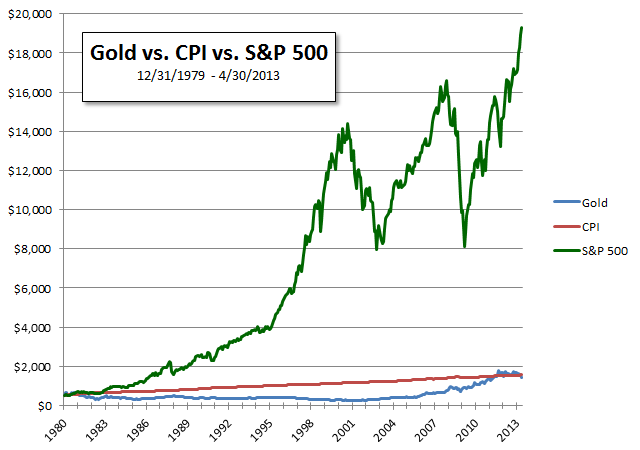
However, Gold does not produce any value by itself. It is just that; Gold. Warren Buffett does not believe in it as it does not create value to itself and its speculative nature. There is not much practical usage to Gold, hence, we cannot rely on market demands in our investment strategy. I do appreciate the value that Gold brings to our portfolio and it is included in Ray Dalio's all-weather portfolio. You can also see that Gold underperforms the S&P 500 in the picture below

Essentially: If you want to incorporate Gold into your portfolio, sure. But it should not be all of it. 

With that, I hope that you have a better understanding of Gold as a financial instrument. 

Till next time, 
Stay vested, stay frugal my friends. 

Dionysius

Gold vs. CPI vs. S&P 500


Blue line is the Dow Jones Industrial Average (30 most influential stocks in the US) and the Orange line is Gold.


Sources:
https://www.investopedia.com/gold-4689769
https://www.thegoldbullion.co.uk/the-advantages-and-disadvantages-of-investing-in-gold/
https://www.thebalance.com/pros-and-cons-of-owning-assets-like-gold-1290619
https://thecollegeinvestor.com/12481/the-pros-and-cons-of-investing-in-gold/
https://blog.moneysmart.sg/invest/investing-gold-singapore/
https://blog.seedly.sg/how-to-invest-in-gold-singapore/
https://www.fool.com/investing/does-warren-buffett-invest-in-gold.aspx
https://www.marottaonmoney.com/since-1979-the-sp-500-grew-13-5-times-greater-than-the-price-of-gold/
https://www.macrotrends.net/2608/gold-price-vs-stock-market-100-year-chart

Saturday, May 2, 2020

Finance 101: What is a Hedge Fund?

Hi friends, 

I will be diving into hedge funds for this post. I'm not sure about you, but in my perception, a Hedge fund is really prestigious and yet shrouded in mystery. Like, what do they do and what are they for? Allow me to answer that in today's post:

Definition:

Hedge funds are alternative investments using pooled funds that employ different strategies to earn active returns, or alpha, for their investors. Hedge funds may be aggressively managed or make use of derivatives and leverage in both domestic and international markets with the goal of generating high returns - Investopedia

A hedge fund is a sort of investment partnership or pooled investment structure that is setup by a money manager or registered investment advisor. - DrWealth

Here are the keywords:
1. Pooled funds/investment - From other investors and the fund's manager
2. Aim to generate high returns - By going into derivatives and leverage (Hedging)
3. Only accessible to accredited investors - You have to be really rich to gain access
4. Less regulated than mutual funds - They can invest using a wider set of financial instruments
5. Actively-managed investment style

So... What is a Hedge Fund?
Imagine: I discovered a way to exploit the market (I honestly don't know in what way) by using derivatives that would allow me to above-average return. That would be my strategy. From there, I put in $20 million and pooled $200 million from other investors and set up a fund where I promise to deliver returns given a fee for my services. 


The benefit for me is that I am paid a fee for my services and from the original fund, I can leverage (let's say I borrow another $400 million from the bank) to make even more return. Because of the less regulation of Hedge Funds, I can look at other instruments, beyond stocks, bonds, etc. Usually, a fund would specialise in one particular field (like junk bonds, real estate, wine, whiskey, patents, etc)

So now that we know what is a hedge fund, let us look at the advantages and disadvantages:

Advantages:
1. Alignment of interest (As the fund manager has his money inside the fund, his aim is to increase his wealth)
2. Flexibility (Due to the lesser regulations, Hedge Funds can be flexible in their investment approach)
3. Professional Management (You have a manager that professionally manages your money)
4. Diversification (Hedge Funds may use other instruments to diversify their risk)
5. Potential to do better than the market

Disadvantages:
1. Less Transparency (Due to the lax regulation, there is not much transparency in Hedge Funds)
2. Fees (You would have to pay for the manager's services)
3. Understanding of Strategy (You might not understand the strategy employed by the fund due to the complexity) 
4. Low liquidity (You can only redeem quarterly or a set period)
5. Potential to do worse than the market 

Thoughts and comments:
In Singapore, you would have to be an accredited investor before you are allowed to invest in Hedge Funds. This would mean that you have either S$2 million in net personal asset or income of S$300,000 in the past 12 months or a corporation with net asset more than S$10 million.  I am definitely not one. Hence, I do not have any reasons to invest in them. 

If you are interested, these are the criteria to select a good hedge fund:

1. Investment Approach - Do you believe in the strategies applied by the fund?
2. Fund Manager - How much is the manager vested in the fund? Why should you put your money with him?
3. Fund's liquidity - What is the redemption period in the year?
4. Amount of marketing/ pitching the managers have to do - If the manager is that good, does he need to market his hedge fund to you?


Personal Portfolio:
As mentioned, I am not an accredited investor (when I am, I'll tell you k?) As you guys have already known, I am a firm believer of the efficient market hypothesis, that no investor can consistently exploit the market. Hence, even when I am an accredited investor, I would not have a big portion of my investment in hedge funds 

There a lot of famous hedge fund managers out there. I'll just list a couple out here:
1. Ray Dalio (famous for predicting the 2007 Global Financial Crisis, He has also managed one of the biggest hedge funds in the world - Bridgewater Associates)
2. Michael Burry (famous for being portrayed by Christian Bale in the "Big Short", he also managed Scion Capital from 2000 to 2008. He successfully took advantage of the 2007 financial crisis and shorted the housing market.)

On the other side of the spectrum, Warren Buffett did make a bet with the top Hedge Fund managers that investing in the market index would generate a larger return compared to Hedge Funds. If you are interested, you can take a look at this article: https://www.investopedia.com/articles/investing/030916/buffetts-bet-hedge-funds-year-eight-brka-brkb.asp. It also shows us that fees really do play a huge role in the returns that we get from our investors. 

I hope that you now have a better understanding of Hedge Funds

With that, 
I end today's topic. 

Stay vested, Stay frugal my friends,
Dionysius


https://www.straitstimes.com/business/banking/worlds-biggest-hedge-fund-returns-found-in-singapore
https://www.drwealth.com/hedge-fund-singapore/
https://www.fa-mag.com/news/how-o-select-hedge-funds-5267.html
https://seekingalpha.com/article/4266569-how-to-pick-hedge-funds-3-common-traps-to-avoid
https://www.investopedia.com/articles/investing/102113/what-are-hedge-funds.asp
https://www.investopedia.com/terms/h/hedgefund.asp
https://infoforinvestors.com/investing/alternative-investments/hedge-funds-pros-cons/
https://seekingalpha.com/article/4266569-how-to-pick-hedge-funds-3-common-traps-to-avoid
https://insidermonkey.com