Showing posts with label Financial Crisis. Show all posts

Wednesday, May 6, 2020

Finance 101: What is Gold?


Hi friend,

Today I shall be looking at Gold as a financial instrument. From ancient times, Gold has been an extremely sought-after object, from the ancient Egyptians to wall street investors. Gold has always been perceived as a form of luxury and riches. Even though Gold has few practical usages outside of industrial applications, and there are metals that are rarer than Gold on Earth, Gold is the highest-priced rare metal.

This concept of Gold having a high perceived value is important to us. As it would mean that Gold has value because we believe that it has value collectively. With that understanding, let us move onto the definitions:

Gold is often looked at as a store of value, but it's also a highly speculative asset linked to currencies and interest rates. - Investopedia

Erm... This is the first time where Investopedia's answer is not comprehensive. 

Allow me to explain the Unique-Selling-Point (USP) of Gold:
1. Function as a store of value - Gold is widely accepted in the world. This is important in countries where the currency is unstable. 
2. Negatively correlate to the market in times of volatility - Example would be during a financial crisis, Investors would flock to Gold due to its relatively stable prices. 
#I will be doing a study to look at the correlation of different financial instruments with stocks. #
3. Limited supply - Has a tendency to increase in value

"That's great! How do I invest in it?"
Woah. Wait, let me go through the advantages and disadvantages. 

Advantages:
1. Acceptable form of currency everywhere
2. Hedge against inflation and a down market (When the market is fearful)
3. Easy to buy and well-established financial institutions that regulate Gold
4. It makes you happy when you physically touch it. 

Disadvantages:
1. Large spread and fees if you were to buy it
2. Storing physical Gold is troublesome
3. Gold can still have fluctuations in prices
4. If your country does not have establishments that allow you to liquidate Gold at a fair price, it will be useless to have Gold. 

How to buy Gold?
1. Physical Gold (In Singapore, you can purchase it from UOB, or Gold retailers, or Gold Jewellery) 
2. Gold Certificates (These certificates allow you to exchange for cash or Gold readily)
3. Gold Savings Accounts (UOB has this. It saves you the hassle of finding a place to store the physical Gold)
4. Gold ETFs or other funds (SPDR Gold Shares ETF)
5. Buying Gold-related companies (like K92 Mining Inc. (KNT) - Gold Mining Companies)

Thoughts and Comments:
I cannot deny that looking at a pile of glittering Gold invokes an irrational sense of joy in me (I have never seen it before. If you have, I would like to see it please). There is a reason why we would want Gold in our portfolio as well. It can serve as a damper to it, especially in times of market volatility. 

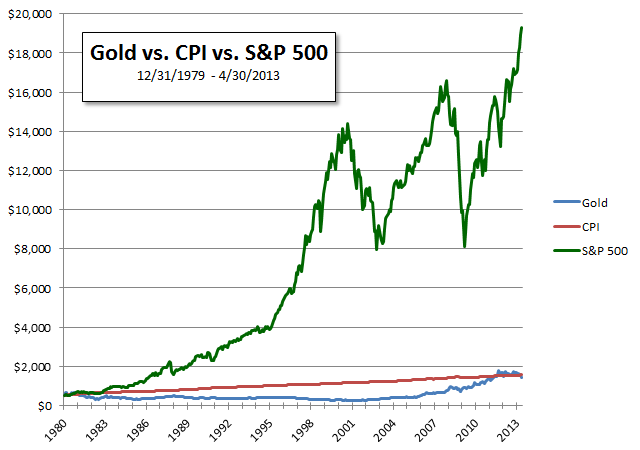
However, Gold does not produce any value by itself. It is just that; Gold. Warren Buffett does not believe in it as it does not create value to itself and its speculative nature. There is not much practical usage to Gold, hence, we cannot rely on market demands in our investment strategy. I do appreciate the value that Gold brings to our portfolio and it is included in Ray Dalio's all-weather portfolio. You can also see that Gold underperforms the S&P 500 in the picture below

Essentially: If you want to incorporate Gold into your portfolio, sure. But it should not be all of it. 

With that, I hope that you have a better understanding of Gold as a financial instrument. 

Till next time, 
Stay vested, stay frugal my friends. 

Dionysius

Gold vs. CPI vs. S&P 500


Blue line is the Dow Jones Industrial Average (30 most influential stocks in the US) and the Orange line is Gold.


Sources:
https://www.investopedia.com/gold-4689769
https://www.thegoldbullion.co.uk/the-advantages-and-disadvantages-of-investing-in-gold/
https://www.thebalance.com/pros-and-cons-of-owning-assets-like-gold-1290619
https://thecollegeinvestor.com/12481/the-pros-and-cons-of-investing-in-gold/
https://blog.moneysmart.sg/invest/investing-gold-singapore/
https://blog.seedly.sg/how-to-invest-in-gold-singapore/
https://www.fool.com/investing/does-warren-buffett-invest-in-gold.aspx
https://www.marottaonmoney.com/since-1979-the-sp-500-grew-13-5-times-greater-than-the-price-of-gold/
https://www.macrotrends.net/2608/gold-price-vs-stock-market-100-year-chart

Wednesday, April 22, 2020

Finance 101: What is a REIT?

Hi friends,

I shall be talking about something that is considered safe and value would never fall in a country with a limited supply of land: Properties, more specifically; Real Estate Investment Trusts (REITs):


A real estate investment trust (REIT) is a company that owns, operates, or finances income-generating real estate. Modeled after mutual funds, REITs pool the capital of numerous investors. This makes it possible for individual investors to earn dividends from real estate investments—without having to buy, manage, or finance any properties themselves. - Investopedia
When you invest in a real estate investment trust (REIT), your money is pooled together with other investors' in a collective investment scheme that invests in a portfolio of income-generating real estate assets such as shopping malls, offices, hotels or serviced apartments. - Moneysense.gov.sg

As we can see from the definitions, the keywords are:
1. Owns real estate 
2. Pool the capital of other investors - Similar to ETFs and mutual funds
3. Income-generating investments - The income is generated from the rents paid by the tenant of these real estates 

So.. What is a REIT? 
Essentially, the trust managers would take the money gathered from a pool of investors, to buy properties like malls, office buildings, hospitals, etc. The spaces are leased out to tenants (think of shops in a shopping mall - Uniqlo, h&m, texas chicken). The profits from the rent collected after paying off the loans and fees borrowed to buy the properties are then distributed to the unitholders (similar to stockholders receiving investments). This is called distribution yield.

Here are the sectors that a REIT may specialise in:
1. Retail: (Shopping malls):

This is the most common one in Singapore, however, it is also easily affected by economic conditions. In a downturn like 2020, there might not be visitors to a mall and the tenants may default on their rents. A strong REIT would be one with a lot of stable tenants (think big brands) that can afford to pay the rent during an economic downturn and good foot traffic.  

2. Hospitality (Hotels, some residences)

This also easily affected by economic conditions, in a downturn like 2020, where there are basically no tourists, hospitality REITs are at a disadvantage as they no longer have any income. Hence, they will experience more volatility because of external market conditions. 

3. Commercial (Office buildings)

Commercial REITs are relatively more stable as the lease agreements with the tenants are longer in duration. Also, if the tenants are majority larger and more stable corporations, even in an economic downturn, the inherent income of the REIT would not be affected. 

4. Healthcare (Hospitals, nursing homes)

Healthcare REITs are expensive in Singapore. This is as Singapore is facing an aging population, we expect an increase in the demands for quality healthcare in the future. Singapore is also positioned as a location for quality healthcare for the region and investors know about it. 

I would say that healthcare REITs are stable, provided they have the proper management and loan ratio. 

5. Industrial (Data centers, warehouses, logistics buildings)

Industrial REITs are dependent on the type of industries that they cater to; some industrial REITs may focus on logistics buildings and when imports are not doing well, they would be negatively affected. 

However, they are also more stable as the lease agreements are also typically longer. 

Advantages of REITs:
1. Diversification (You would be investing in more than 1 property most of the time)
2. The steady stream of income through distribution yield (Passive income)
3. The gradual increase in property value (Especially relevant in land-scarce Singapore)
4. Liquidity (As Reits are sold on the stock market, transaction can occur immediately)
5. Low cash upfront (As compared to owning actual properties)

Disadvantages of REITs:
1. Exposure to only one sector (As a REIT usually focus on one sector, you would be exposed to the downside of the sector in certain economic conditions)
2. Management fees (As REITs are actively managed, fees are required to pay for their expertise)
3. Volatility (As a REIT is traded on the stock exchange, it is subjected to fluctuations of the stock market)
4. Subjected to changes in interest rates (Reits are allowed to borrow up to 45% of their total assets in Singapore, changes in interest rates might negatively affect the operations of these Reits) 

How to consider a REIT:
1. Gearing ratio - The ratio of loans to asset, a low gearing ratio would allow the REIT to take advantage of lower property prices in an economic downturn. 
2. Management team - A good management team would make the correct decisions, such as increasing the gearing ratio when property prices are cheap
3. Outlook on the sector/ industry and the properties - If you think that over the long run, the specific sector will not do well, you should probably avoid, likewise for the price of the property that the REIT is managing
4. Occupancy Rate - A higher occupancy rate would mean that there are more distribution yield 
5. Tenants retention rate - A higher retention rate would mean more tenant are willing to continue their lease with the property
6. Fees - High fees would definitely dig into your returns. But if you're paying for the right team to deal with rationale tenants, unlike mutual funds, you would get return for your money 
7. Distribution yield - A history of consistent distribution yield could be an indicator that it will continue to pay out the same distribution yield in the future. 

Thoughts and comments:
For my personal portfolio: I have about half in REITs through my REITs ETF at the moment. If the price of the ETF is to keep falling, then I may consider increasing my weightage to take advantage of the low price. I love the idea of collecting passive income as a landlord. kekekeke. 

Do your own due diligence when it comes to investing, I am not recommending you to buy anything. 

With that, 

Stay vested, Stay frugal my friends, 
Dionysius


Sources:
https://www.investopedia.com/terms/r/reit.asp
https://www.drwealth.com/singapore-reits/
https://www.moneysense.gov.sg/articles/2018/10/understanding-real-estate-investment-trusts-reits

Wednesday, April 15, 2020

Mid April Update: Importance of emergency funds and a financial framework

Hi friends, 

I just needed an update: My internship was terminated due to the Corona Pandemic and my side hustle got halted also because of the pandemic. I have definitely lost >80% of my normal monthly income. Sad to say, most of my family members are also experiencing the same problem. 

I hope that the same situation would not happen to you. Trying to find another internship and finding more side hustles are mentally draining processes especially in this climate. So now I have a lot of time to write and plan the contents for this blog and learn python to upgrade myself. 

I feel that this is a good time to convey to you my financial framework and it is because of this framework (and the resilience package) that I can sustain my lifestyle in this climate despite my loss in income. I believe in the tier-model of personal financial planning, in that each tier would take care of my goal in terms of time horizon. Allow me to introduce it to you and I will only move on to the next tier after I prepare one tier:

I will be speaking in very general terms, you should tailor it in accordance to your situation.


1. Emergency Funds (6-12 months of your monthly expenses):
Instruments - High yield saving account (You need it to be as liquid as possible)

This is the first and most important step in my personal finance planning. I have about 8 months' worth of expenses saved in my bank account and it's because of this that I can maintain my current lifestyle. 

The emergency fund is meant to allow you to maintain your current lifestyle in the event that you experience a loss of income. This can be due to a loss of a job, quitting for a new horizon, etc. The emergency funds also serve as your holding power, such that if you lose your job, you would not have to dig into your investment (which might be at a loss at that moment). 

If you have a business. you would want to prepare a cash reserve of around 12-18 months such that you can maintain your business in the event of something like the Covid-19 situation. During this period where other businesses are dying, you would be positioning yours for accelerated growth. 

2. Insurance (Term life: How many years it takes for your dependents to be independent, Accident and Critical illness: more than 5 years of your living expenses and Hospitalisation: To your own preference):
Instruments - Insurance

For more, please refer to my finance 101: What is an insurance? The main point about insurance is such that you are able to hedge against the long-term loss of income due to accident, critical illness, death. 

Emergency funds would take care of your short term issues like loss of jobs. Insurance would protect you from unwanted events that might devastate your whole life (long term impact). 

You might be tempted to buy a whole life plan, adding in critical illness and accident protection. But I would urge you to compare the differences in price. You could invest this difference and after a long period of time, you would make back the amount. Furthermore, the cash value of a whole life plan is not guaranteed as the company would decide how much interest/bonus you would receive. 

3. Short-term investment (1-5 years goals like the downpayment of a house, car, etc):
Instruments - Bonds, Bond Funds, CPF, Short-term Endowment

These are goals that you would need to fork out money for in quite a short period of time. This period of time would mean that you would not want to invest too aggressively in stocks, but rather, you should aim such that your stash of money would hedge against inflation and not to make much returns.

4. Long-term investment (For goals like retirement, education, you have a long time horizon. around 20 - 30 years):
Instruments - ETFs, Stocks, Mutual Funds

Due to the inherent volatility of stocks, I would only recommend that you look to them if you have super long-term goals that you would want to achieve. I say this as in the long run, the stock market has a historical return of around 8%. This would also be the last tier of your financial planning. If you have completed tier 1-3, your excess income should come here, such that your money can work for you. 

A very simple way to visualise would be using the rule of 72: It would roughly take 9 years of compounding for your money to double. Imagine having 30 years to invest. your money would grow to almost 8 times of its original amount. 

As everyone's financial situations and goals are different, feel free to tailor this framework. If you have any questions, do feel free to approach me. I do not mind helping you clear some of your doubts. 

With that, 

Stay vested, stay frugal my friends,
Dionysius 

Saturday, March 28, 2020

Active management allows for better performance in market downturns?

Hi friends,

One of the counter-arguments brought-forth by active management believers would be that they can utilise some other instruments (bonds, derivatives, or even cash) in a market downturn to achieve better performance in a market downturn (like the one that we are having now). Thus, I will be examining if this saying holds up when we look like historical data:

Links:
1. https://www.onedayinjuly.com/active-vs-passive-in-down-markets
2. https://advisors.vanguard.com/iwe/pdf/FASAPMSM.pdf
3. https://advisors.vanguard.com/iwe/pdf/FASAPCM.pdf
4. https://www.morningstar.com/articles/852864/will-active-stock-funds-save-your-bacon-in-a-downturn
5. https://us.spindices.com/documents/spiva/persistence-scorecard-december-2019.pdf?force_download=true

From the POV of active investment:
Passive investments would rely on the market index (index funds/ etfs) for their investments. As the market goes into a downturn, active investment would shine as they would often own stocks that are outside of the index. This would mean that they have the potential of performing better than the market index when it goes down. A skilled manager would only pick the good stocks in the stock market and hence, it should perform a lot better than just buying all the stocks in the market using index funds.


Looking at the figure above, we can see there in a bear market, active managers do perform better than compared to a bull market. Hence, from a short-term perspective, active managements can be considered as a way of investment (Provided that we can choose the ones capable of choosing the right stocks)


However, when we attempt to look at things from a long-term perspective (i think of around 10 years?). The graph above actually shows that for the top 20% actively-managed funds in one crisis, only 23% would remain in the top 20% for the next crisis.

Effectively, only 4.6% of actively-managed funds would remain in the top 20% in their performance for a period of 2 crisis. The issue of how we want to select this 4.6% is beyond me, as I believe that it is more likely due to luck that they actually remained in the top 20%. Evidently from the 77% that actually slide below the quintile.

The same also applies if we look at the US small-cap funds and emerging market fund. Please look at link number 1 for that.

Also, looking at the SPIVA scorecard, which includes 12 equity buckets spread across Large-Cap, Mid-Cap, Small-Cap, and Multi-Cap. Each of those four broad categories is further divided into Core, Growth and Value sub-categories. The 13th category is Real Estate funds. The SPIVA score card has data started in 2001. 

Looking at the 2001 dot com bubble burst and the 2008 financial crisis, only 4 out of 13 of the categories has more than half of the active funds beating their respective index in 2001. In 2008, only 2 our of 13 of the categories has more than half of the active funds beating their respective indexes.  


Hence, even in a market down turn, we are unable to see substantial evidence that active management would perform better than their respective indexes. This is especially evident in the previous paragraph, where only 4/13 of the categories of active funds out perform their indexes in 2001, only 2/13 of the categories of index funds out perform their indexes in 2008. 


In conclusion: when we look at the short-term perspective, there are indeed a substantial proportion of active funds that will outperform the market (50%, so if you would want to choose a fund, you can choose to flip a coin), However, in a long-term perspective, there is no substantial evidence that active management would consistently perform better than passive-investments. Between one crisis to another, there is no consistency in which fund will always do well in the crisis.