Saturday, June 20, 2020

Book by the Giants: Money: Master The Game

Hi friends, 

Today, I will be talking about the third finance book I have read - Money: Master the Game by Tony Robbins. This book offers quite a comprehensive guide to basic financial planning while taking a look at the common financial planning pitfalls that you may encounter in your journey (like how your financial planner may not have your best interest in mind, myths about actively-managed funds, how fees can negatively affect your returns in the long run). Furthermore, the author has used very specific examples with proper data to back up what he is saying, which is something that I value when we talk about finance.

Without further ado, let us look at the content of the book chapter by chapter:

Chapter 1 (Laying the groundwork):

1.1 "It's your money! It's your life! Take control"

In this part, Robbins started with a broad look at finance. He invokes this desire of money in the reader by asking them to imagine what it will be like to be financially free. Then, Robbins mentioned the disadvantages normal people like us faced when it comes to investing (Like High-Frequency-Trading, technical financial jargon designed to confuse us). He mentioned financial giants like John Bogle, Ray Dalio, Carl Icahn, which he interviewed in later chapters and lure the reader to keep reading to find out what they have to say to the average investors to allow them to have good returns regardless of what economic situation we are in. 

Honestly, it sounds a lot like what I always preach on this blog, that we should take our money matters into our own hands and not let anyone take control of it for us. And what I wish to do is to educate my readers such that they can be financially savvy enough (you only need about 3 months) to make their own financial decisions without being influenced by external information. 

1.2 "The 7 simple steps to financial freedom: Create an income for life"

For this part, Robbins has started to shine a light on the reality that we will face in the future. That our current way of living and saving is inadequate to fund our lives for retirement. He then used comprehensive data to tell us how our lives will be affected if we were to rely on social support structures to support our retirement. He also illustrated the importance of compounding when it comes to investing. 

He then elaborated on some financial mindset things that I skipped over because they aren't that interesting to me and gave an outline of the entire book for the audience. Singapore is also mentioned in the book. Our average household spends $4000 a year on the lottery, imagine investing that amount every year. :')
1.3 "Tap the power: Make the most important financial decision of your life"

Robbins further elaborated on the power of compounding in this part and talked about the importance of saving money. He gave examples like Michael Jackson, Mike Tyson, who managed to spend all of the money that they earned. He started to talk about the idea of passive income, where we do not trade our time for money (like a job), but there will be money coming in whether we are working or sleeping. 

He then gave very good examples of people with low income but yet, by saving their income (paying ourselves first) and relying on compounding interest, they made a great impact on the money they have. He also stated another important concept; Lifestyle Inflation, how it is important for us to maintain our lifestyle when our income increase so that we can save more. 

1.4 "Money Mastery: It's time to breakthrough"

We read about the importance of not letting our money define who we are. But rather, what we do with our money is more important. Robbins reinforced this idea by contrasting between Adolf Merckle and Chuck Feeney. He emphasized the need for us to give back when we are capable, and this would give us the proper significance in our lives. 

Chapter 2 "Becoming the Insider: Know the rules before you get in the game"

2.0 "Break Free: Shattering the 9 financial myths"

This is one of my most favourite chapters, I really like how Robbins used data and stats in debunking those financial myths that we often hear from financial planners/insurance agents. Furthermore, he has stated the inherent misalignment in interest between the planner and the consumer. A large part of the financial planning business is based on sales and the planner’s salary (his interest) would be based on selling you (like endowment, ILPs, etc). Hence, if you are someone who does not know anything, you might very well be buying products that you do not need or inferior products.

He has split the 9 myths into different sections. I will just be listing them out.
1. 13 trillion dollars can’t be wrong “Invest with us, We’ll beat the Market!”
2. “Our fees? They’re a Small Price to Pay!”
3. “Our returns? What you see is what you get!”
4. “I’m your broker, I’m here to help”
5. “Your Retirement is just a 401(k) away”
6. Target-Date Funds: “Just set it and forget it”
7. “I hate Annuities and you should too”
8. “You gotta take huge risks to get big rewards
9.“The lies we tell ourselves”

Allow me to elaborate on each point, starting with Myth 1: “We’ll beat the Market”:

As I have frequently emphasised, studies have shown that active funds managers consistently underperformed the market index when it comes to long-term performance. Robbins has used a specific timeframe in his examples: From 1984 – 1998, only 8 out of 200 fund managers beat the Vanguard 500 Index. Also, from 1993 to 2013, the S&P 500 returned 9.28% on average annually, but the average active fund manager made just 2.54% annually.

He then balanced out the argument by listing out the small number of investors that outperformed the market. However, they do not accept new investors and honestly, no one can reliably predict which fund manager can do better than the market consistently.

Myth 2: “Our fees? They are a small price to pay!”

This is something that is close to my heart. Most mutual fund investors are not told about the fees associated with the mutual funds or told the lie that the fees are really low (Without being informed about the lower fees of other investment instruments). Furthermore, mutual funds seem to purposely hide their fees through a lot of technical jargon (like platform fees, account management fees, advisory fees, distribution cost, bookkeeping fees, redemption fees), which makes the calculation of the fees extremely confusing and frustrating. He used an example of Robert Hiltonsmith (He has a PhD in economics, and he could not understand the 17 types of fees charged to him). He also gave a list of all the fees associated with 401(k) management; you can take a look at them for reference for your mutual funds

In this part, Robbins has given an average cost of mutual funds; 3.17% a year. This means that, for your investment to not lose money, it must return 3.17% every year consistently. Compare that with an ETF, which is in the 0.4% range (He stated 0.14% in the book).  He equated it to paying 30 times more for a Toyota when your neighbor is driving a Ferrari. The example below is for a 30 years’ time horizon

He then recommends some websites that will help you estimate your cost of investment. But I am not going to link it here. If you are interested, approach me by number or email.

Myth 3: “Our returns? What you see is what you get”

Definitely, the returns that we see on the fund’s product summary is not accurately reflective of the true returns. The returns on the summary are based on time-weighted returns, which is wrong according to Robbins. He has said that the money/dollar-weighted returns would be a more appropriate reflection of our investment returns.

Myth 4: “I’m your broker, and I’m here to help!”

As we have established at the beginning of chapter 2, we are paying a lot more money (fees) to receive returns that are a lot lesser than the market returns over a long period of time. Your broker is not here to help, he is here to sell a product so that he can receive that salary in terms of commission for himself. Robbins has also shared that 49% of mutual fund managers do not own a stake in the fund that they manage. Hence, you can see that there is no inherent interest for them to maximise your returns. Furthermore, a large portion of the remaining 51% of mutual fund managers do not have a significant stake in the funds they manage.

Furthermore, in the financial planning industry, your financial planner only needs to sell you a product that is “suitable”. Note: Suitable, not the best product that caters specifically to your need. Example: You mentioned that you want to invest, you might be sold an investment plan, simply because it is suitable to your need, not because it is the best product. This is where Robbins came in with the idea of a fiduciary financial planner, where it will be in his interest to make you money – By taking commissions out of the equation. They charge on a case basis.

I have skipped myth 5,6,7,8,9 as it is not that applicable to the Singapore context and my context.

Chapter 3 what’s the price of your dreams? Make the game winnable

3.1 Calculating the exact number of your dreams

In this section, Robbins talked about the different level of financial achievement and the readers are encouraged to calculate out the magical number that helps him to retire off the yearly returns (dividends, capital growth, coupons) of his investments :

1.    Financial Security

At this stage, security would mean that the returns of your investment (roughly 4-6%) would cover your mortgage, food, utilities, transport, and insurance. Robbins estimated these expenses account for about 65% of a household’s monthly expenses.

2.    Financial Vitality

Vitality would mean that the returns covers for everything in Financial security + some form of luxury (half of clothing cost, half of dining and entertainment cost, and indulgence cost like gyms or manicure or gaming accessories).

Having this amount of investment would mean that half of your wants in life would be covered by your money that is working hard to bring you more money without you working.

3.    Financial Independence

At this stage, your yearly returns are the same as your yearly expenses at the current lifestyle (all wants, needs, emergency). You no longer need a job to sustain your lifestyle

4.    Financial Freedom

At this stage, your yearly returns would allow you to contribute to causes that you believe in, like the annual donations to charity, having a yearly vacation to an exotic island

5.    Absolute Financial Freedom

It is the same as financial freedom, but you can do all those things as and when you want, which is provided by the returns of your investment.

3.2 What is your plan

In this section, we can read about the specific steps that we can take to achieve the different levels of financial achievement. These can be stuff like paying off our debt, lowering our taxes, using tax – efficient low-cost investment vehicles. Robbins has challenged the readers to make the decision to start working towards achieving their financial dreams.

3.3 Speeding up the process of achieving

1. Saving money and investing the difference

Robbins challenged the readers in this section by asking them what are the things that they can afford to save – What are the needs and wants in our lives? Also, he advocated for an automated savings/investing method starting at 3% of your annual income. You are supposed to increase this amount every time you receive a pay raise. This method would be useful for people that claims that they cannot save money (Just start with 3%.)
Also, he gave an example that I like – Buying expensive cars or coffee or clothes that you must have, do you really need it? He encouraged the reader to think of daily little expenses that can accumulate to a big amount over a year.

2. Earning more and investing the difference

The second way is to earn more money. He challenged the reader to get that pay raise by being more valuable at work by increasing the values that they bring to their job (Something he learned from his mentor – Jim Rohn). Essentially, invest in your skills or yourself so that you can demand a higher salary. He then gave some examples that for high-income earners, when unemployment strikes the market, they are not as affected as the lower-income earners. So yes, keep upgrading yourself, learn more so that you can contribute more to the company then demand that higher pay

3. Reduce fees and taxes and investing the difference

Look at the investment fees that you are paying, are there alternatives that you can go to so that you can lower that fee (from 2% to 0.5%)? The differences in fees, when compounded over a long period of time, would add up. Are there grants in our taxes that we are not utilising to drop down to the next tax bracket? Learn about how to do your taxes so that you can benefit and invest the savings.

4. Get better returns and speed your way to victory

This is done through asset allocation that are optimised for your financial objective, risk appetite, and time horizon. Robbins mentioned about Ray Dalio’s all-weather portfolio and how it is has a back-test result of more consistent returns compared to a pure-stock portfolio. He also mentioned about the rule of 72, which 72 divided by your rate of returns would be roughly the number of years for your investment to double.

5. Change your life and lifestyle for the better (moving to better places to take advantage of better tax and lower cost of living)

In this portion, Robbins challenged the reader to consider living in places that have better tax advantages, lower cost of livings without compromising much on the income. This would accelerate your journey in reaching your financial goal in the long run.

Chapter 4 Make the most important investment decision 

of your life

4.1 The ultimate bucket list: asset allocation

The reader is introduced to the importance of asset allocation – Which affects our long-term returns (Which is essentially diversification across different financial instruments) Robbins has introduced different financial instruments.
The security/ peace of mind bucket instruments are Cash/cash equivalent, Bonds, Compound Deposits, Homes, Pension, Annuities, Life Insurance policies, Structured notes

4.2 Playing to win: The Risk/Growth Bucket

The Risk/Growth markets are Equities (ETFs or individual stocks), High-yield bonds, Real estates (or REITs), Commodities, Currencies (Forex), Collectibles (Exotic things like cars, painting), Structured notes

Robbins then introduced Yale’s portfolio, which is 20% in US stocks, 20% in international stocks, 10% in Emerging market stocks, 20% in REITs, 15% in Long-term Treasuries, and 15% in Treasury inflation-protected securities. 70% are inequities (For long-term growth), 30% in defensive financial instruments (Downside protections) It has an annual return of 7.86% between 1997-2014, while the S&P 500 dropped 51%. During periods of loss, from 2000-2002, the S&P 500 dropped almost 50%, but the Yale portfolio only loses 4.572% over the same period.

4.3 The dream bucket
In this section, Robbins drew our attention back to the reason for amassing wealth/ generating returns. Wealth is supposed to improve our quality of life or to improve the lives of others.

4.4 Timing is everything?

Robbins introduced another concept of investing; Dollar-Cost-Averaging, which helps to prevent emotions from taking over in our investing and would give better returns in the long run and of course rebalanced annually. He wrote it in a very easy summary – Diversification between asset classes, markets, and time.

Chapter 5

5.1  Invincible, unsinkable, unconquerable: The All Seasons Strategy

In this chapter, we are given more elaboration on the history of Ray Dalio, and his flagship fund – Pure Alpha, which consistently outperformed the market or continues to profit when the market is in a downturn. (An average of 21% return annually and 17% in 2008)
Robbins then asked Ray in an interview to give a portfolio that would perform consistently in any market, in which, Ray replied that a balanced portfolio is not a 50/50 stock/bond allocation (in a 50/50 portfolio, stocks would account for 95% of the total risk of the portfolio). He stated that a balanced portfolio that would do well regardless of any economic conditions would be equally distributed in terms of risk.

Ray Dalio then talked about the specific asset allocation:
1.    US Stocks (30%)
2.    Long-term US government bonds (40%)
3.    Intermediate US government bonds (15%)
4.    Gold (7.5%)
5.    Commodities (7.5%)]

5.2  It’s time to thrive: Storm-Proof returns and unrivaled results

Robbins then backtested this portfolio for 75 years and all the way till 1928. Here are the results:
From 1939 – 2013

From 1928 -2013

Returns in each market downturns

5.3   Freedom: Creating your lifetime income plan

For 5.3,5.4,5.5, Robbins talked about annuities as a possible instrument for retirement planning. Which is something that I have no interests in as the types of annuities that he talked about are also not that available in Singapore and only for the accredited investor.

5.4  Time to win: Your income is the outcome

5.5  Secrets of the ultrawealthy

Chapter 6

6.0 Meeting the Masters

We are introduced to some of the people Robbins has interviewed for this book, they specialized in different markets, different investment approaches, and different financial instruments. But Robbins has summed up the things that they have in common in this section:


1. Don’t lose (Control the amount of money that you can lose, cut your downsides
2. Risk a little to make a lot (Find opportunities to receive an asymmetric risk/reward
3. Anticipate and Diversify (After finding these opportunities, anticipate the failures and diversify your risks)
4. You’re never done (A lot of the people that he has interviewed do not stop growing, learning, giving. They do not stop even though they have a huge amount of wealth and even after they are advanced in age)

6.1 - 6.12 Transcripts with the Masters 

These are the people Robbins have interviewed and published the transcript of the interview:

1. Carl Icahn (Corporate Raider/ Activist Investor, championing to maximise value returned to shareholders or to install better management in the company)

2. David Swensen (Chief Investment Officer of Yale’s Endowment, turned Yale’s investment from $1 billion to $23.9 billion with a 13.9% annual returns, teaches a class in portfolio construction)

3.    John C. Bogle (Creator of the index fund, Founder and former CEO of Vanguard Group – The second-largest mutual fund company on earth. Critic of the shady practices of the mutual fund industry)

4.    Warren Buffett (CEO of Berkshire Hathaway, 3rd richest person on earth, nicknamed as “The Oracle of Omaha”, most famous value investor)

5.    Paul Tudor Jones (Founder of Robin Hood Foundation and Tudor Investment Corporation, 28 consecutive years of not making any loss in trading)

6.    Ray Dalio (Found, Co-Chief Investment Officer of Bridgewater Associates, the largest Hedge Fund. There is an entire chapter that talked about the All-Season portfolio)

7.    Mary Callahan Erdoes (CEO of J.P. Morgan Asset Management Division, a believer in the value that managers can bring to their clients, increase AUM of the division by 30%, overseeing $2.5 trillion dollars)

8.    T. Boone Pickens (Chairman, CEO of BP Capital Management, made $4 billion, gave $1 billion away in charity, champions for energy independence for the U.S)

9.    Kyle Bass (Founder of Hayman Capital Management, a hedge fund, shorted the housing market in 2008, Greece, and Ireland as well.)

10. Marc Faber (Director of Marc Faber Limited, one of the leading experts on Asia’s growth)

11. Charles Schwab (Founder and Chairman of Charles Schwab Corporation, created one of the first discount brokerages. Charles Schwab grew to be the largest discount brokerage, allowed for the public to invest without a costly middleman. Advocated for 98% of people to go into index funds)

12. Sir John Templeton (Founder of Templeton Mutual Funds, Creator of 1 million Templeton Prize which funds research in science, technology, and spiritual achievements. He invested in maximum pessimism and sell at peak of optimism. He was named the greatest global stock picker for the 20th century)

I am not going to put up the transcript and this post is getting a bit too long, so let me move on to the next chapter.

Note: I have skipped the entire chapter 7 as Robbins switched gear and talked about giving, finding meaning to life and that self-fulfilment stuffs. If you are interested, you can definitely go and take a look. But I am not interested.

With that,
I end today's topic

Stay vested, Stay frugal my friends,
Dionysius


Wednesday, June 17, 2020

Mid-June Update

Hi friends,

I hope that you have been well, especially after going back to work, and adapting to the "new normal" after Circuit Breaker (CB) is over. It has not changed much for me, as the internship that I am doing is counted as an essential service, so I have been traveling to and fro office every day. The major change for me is that I am just hoping for school to start again, as I feel that my brain is starting to lose its mathematical prowess.

Let's talk about the changes that happened:

1. Standard Chartered reduced the JumpStart account's interest from 2% to 1% from 30th June 2020 onwards

This was really hurtful, as the interest generated from the account was substantial. My house's wifi plan was heavily subsidized from the interest. Furthermore, the account has served as an important place for me to park my cash reserve to slowly deploy into the market.

Because of this change, I have decided to move my cash reserve into Stashaway Simple (which a projected interest rate of 1.9%). This is as it is relatively convenient to deploy the money by setting up an automatic transfer from the Simple account to my portfolio.

2. Nasdaq reached an all-time high on the 10th of June 2020, the other US indexes were also near their original peaks

This was mainly due to the market's optimism about the economy opening up again. As you would remember, I have decided to withdraw a substantial amount of my investment in the mid of May last month as I had anticipated a drop. So I was a bit salty and sad that my predictions were wrong. Until point 3

3. A sudden drop of 5% in the S&P 500 from the 10th of June to 11th June.

Yes! The reason why I was kinda hesitant about deploying my cash reserves was that I felt that the market was way overvalued at the 30% rise from the bottom in March. I really felt that there was too much optimism in investors and we weren't looking at the business impact that Covid-19 has caused to the businesses. 

But the drop has sort of shocked the investors by giving them a taste of reality instead of just being optimistic about the current situation. So, anticipating the fall, I have decided to increase my DCA every week (This is done as I have decided to start putting in the money from the Standard Chartered bank account)

Do comment below and let me know how you feel that the market will behave like in the coming months. Are you optimistic? Or are you pessimistic?

Here are the changes to my investment:

1. $1200 every month into StashAway, 1 unit of the S&P 500 in Kristal and 200 into SG REITs

2. I will still try to time the market with the REITs portion. This is my fun money. Too bad. But please don't practise what I am doing. 

3. I will continue to DCA, as I really cannot understand the market's behavior right now. DCA would be the most appropriate way forward. 

With that, 
I end today's topic. 

Stay vested, Stay frugal my friends,
Dionysius


Saturday, June 13, 2020

Investor Spotlight: John Bogle

Hi friends,

This is the first person of my Investor Spotlight series; John Bogle (1929-2019). He was the founder of Vanguard Group (The world’s 2nd largest fund company. He was the man that popularized the concept of the index funds and changed the investment industry for the better (more on this later). 

But yes, let me start of the series properly:

1.      Background

He was born in 1929 in New Jersey. His family had to sell their house that year. He had to start working at a very early age as his family suffered due to the stock market crash. His family was also broken up as his father fell into depression and alcoholism.
Despite so, he graduated university with a major in economics, his thesis titled “The Economic Role of the Investment Company” scored an A+ and also got him a job into Wellington Managements after the founder read it. Subsequently, he rose and rose to the role of Chairman, and got fired due to disagreements with management in 1974. He then started his own fund company – Vanguard Group in 1975 with $1.8 billion under management.

With the new company, he brought index investing to the masses in 1976 (YAS!!) with the first index mutual fund – Vanguard 500 Index Fund. It only had $11 million initially but grew to one of the industry’s largest today. In 1977, Vanguard converted to a no-load system, meaning that investors can have more of their money put into their investment at the beginning stage of their investment. In 1986, Vanguard introduced the first bond index funds to the masses.

In 1996, he retired as Vanguard’s chairman and CEO. In 2000, he retired as the senior chairman and became president of the Bogle Financial Markets Research Center.

2.      Investment Approach

He is a firm believer that lower costs would allow for better returns. Till his death, he could be seen on many podcasts and videos advocating the use of low-cost index funds or ETFs in our investment. He also believes in the alignment of investors’ interests with the fund houses. This is exemplified in Vanguard’s radically different from other investment companies. Instead of having Vanguard manage the funds’ approach for profit, the funds under vanguard were to operate independently to benefit their unit/shareholders. Furthermore, under his direction, Vanguard also converted from a broker-dealer distribution model to a no-load system, which was in line with lowering the costs of investing for the common investors.

Essentially – A low-cost index fund (for diversification of assets), held over a very long time, with dividends, reinvested and investing through dollar cross averaging and balance less than or equal to once per year. He also believes that only stocks and bonds are needed for diversification purposes (He would rather have the whole stock market for his stock portion)

3.      Broader impact on the industry

He has indeed changed the industry for the better. Ever since the first index funds were introduced in 1976, actively-managed funds have shrunk to 51% of the market in 2019. Index funds also control 17.2% of US-listed companies. There has also been an increase in the number of index funds, making the market more efficient.

His innovation has also lowered the fees of other mutual funds by 30-40% within the 10 years index fund was released to the market. His idea of bringing value to his clients has also allowed Vanguard to be the 2nd largest fund company in the world. An estimation of $250 billion dollars was saved for the public investors from the low-cost index funds and the imitators they have inspired.

4.      Personal Impact

Honestly, I did not know about John Bogle, what he stood for, and the impact of his life. However, in some way, my investment approach of using index funds/ETFs using lower costs to invest is inline with the investing philosophy of Mr. Bogle. Even after almost 50 years, the ideas brought forth by the product he launched are still influencing investors today.

He is also a philanthropist, giving away half of his income every year (yet his fortune is at $80 million). His nonprofit “The John C. Bogle Center for Financial Literacy” also aims to educate people on sound financial principle, staying out of debt, minimize investment costs to reach financial independence.

He is a role model for me. I hope to be someone like him in the future, even with a lot of money, still gives back to the bigger community. I also hope to leave my mark on this world like him by lowering fees for investment for investors.

5.      Fun facts
·      The name Vanguard was the name of a ship – HMS Vanguard, which was the flagship in the Great British victory over Napoleon at the Battle of Nile. Bogle wanted the Vanguard Group to be the leader in a new trend
·       Even though he is the chairman of the 2nd largest mutual fund company in the world, he has consistently criticised the mutual fund industries for their hidden fees, bad products, and marketing of misinformation to the public. He earned his reputation of being “The conscience of the industry”.

With that, 
I end today's topic. 

Stay vested, Stay frugal my friends,
Dionysius
Sources:
Common Sense on Mutual Funds

Investor Spotlight: Series Introduction

Hi friends, 

Welcome to this new series called "Investor Spotlight". In this new series, I hope to take a closer look at some of the investors that were mentioned in my posts but did not have the time to really examine.


I will be looking at:

1. Background (Their formative years, careers, choice, etc) 
2. Income-stream/ portfolio (Some of them have multiple income streams, especially the younger ones)
3. The impacts they have on the financial market (Some of them fundamentally changed the market for the better.)
4. The impacts they have on my investment approach and my life
5. Some fun facts about them (I guess?) 

I will also conclude each post with some of the financial and life lessons that I have learned from examining at them and I hope that it will be beneficial for you as well. I believe that every one of them is successful for a reason (especially those that have a rags-to-riches story)


I hope that you will enjoy this series!


With that, 

I end today's topic. 

Stay vested, Stay frugal my friends,


Dionysius

Wednesday, June 10, 2020

Finance 201: What is the All-Weather Portfolio?

Hi friends,  

I hope that you have benefitted well in the previous famous portfolio entry. Previously we have talked about the investment approach of Warren Buffett. Today, I am going to talk about the passive investment approach of a Hedge Fund Owner; Ray Dalio.

Of course, let me start off with some interesting facts about him:

1. He found Bridgewater Associates, which became the largest hedge fund in the world, with US$160 Billion AUM
2. He was not a good student until college, before that, he did not perform academically
3. He predicted the 2007 Great Financial Crisis, Bridgewater's flagship fund gained 9.5% during that period.
4. He signed "The Giving Pledge", committing to giving half of his net wealth to charity. This was done with Bill Gates and Warren Buffett.
5. He was born into a working-class family. He started investing at 13 years old.

Now that you know more about this legendary man. Let us take a look at the portfolio composition of his All-Weather portfolio. Oh right, in an interview for Money Master the Game, Ray Dalio has mentioned that this portfolio of him will produce positive returns most of the time, in any economic environment. Hence, we will be putting that to the test along with the leveraged version of the All-Weather portfolio.

All-Weather Portfolio Composition:
US stocks - 30% VTI
Long-Term Treasuries Bonds - 40% TLT
Intermediate-Term Treasuries Bonds - 15% IEI
Commodities - 7.5% GSG
Gold - 7.5% GLD

Leveraged All-Weather Portfolio Composition:
2x Large-Cap US stocks - 30% SSO
2x Long-Term Treasuries Bonds - 40% UBT
2x Intermediate-Term Treasuries Bonds - 15% UST
2x Commodities - 7.5% DIG
2x Gold - 7.5% UGL

Woah. Hold up. What is leverage?? Alright. This is something that I did not explain in my Finance 101 series. Leverage is like an amplifier, it allows for increased returns, just like how it allows for greater losses. Also, there is a higher expense ratio in leveraged ETF as compared to normal ETFs.

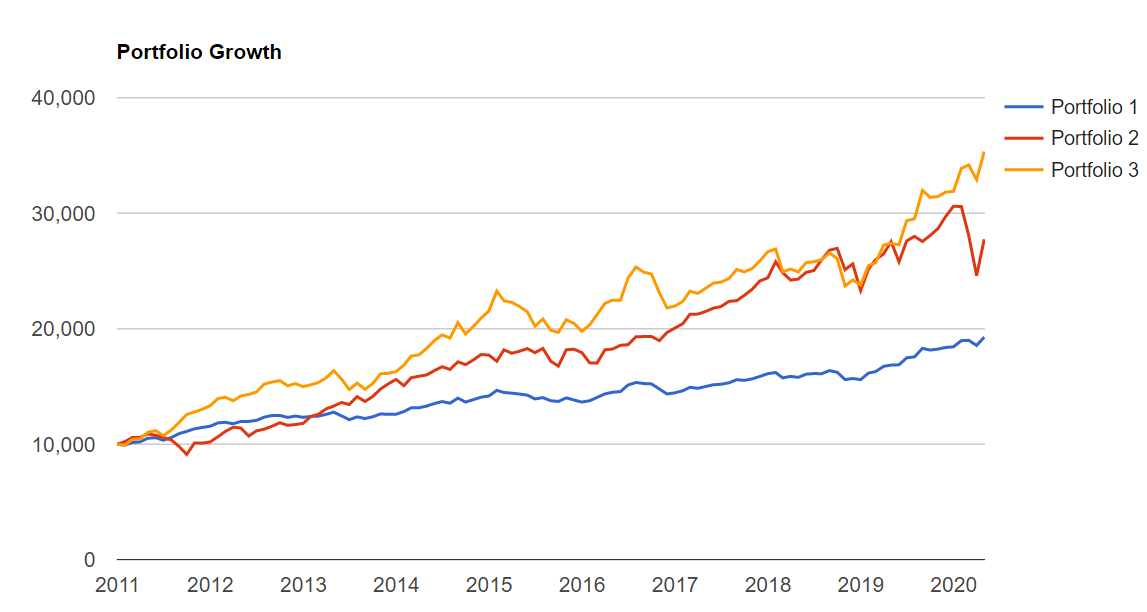
With that, let us take a look at the performance of the All-weather Portfolio (Portfolio 1), the 2x Leveraged All-weather Portfolio (Portfolio 3) and compare it against the S&P 500 (Portfolio 2) (2011-2020) :


As we can see here, the results are kinda surprising. Especially seeing how the portfolio 3 outperformed the S&P 500. This is a higher return, with lower St. Dev and a lower Max. Drawdown. ##Of course, I am not factoring in the cost of investment (Which is higher for a leveraged ETF)## But the normal All-Weather portfolio also has a return 65% of the S&P 500's returns while only 35% of the max drawdown.

If you have remembered, I have taken a look at the distribution of returns of the All-Weather portfolio over the 20 years and 30 years time horizon. Hence, we know that the All-Weather portfolio has this one advantage. It is really really safe. It can protect your assets if you are willing to forsake the potential of a higher return brought by an all-stocks portfolio.

Limitations:
I have only used backward data from 2010 to 2020. Hence, they are not indicative of future performance. I have also not factored in the cost of investments between the different portfolios.  

Thoughts and comments:
Imagine, having this portfolio that will make you money no matter what economic situations we may be in. That would be an attractive option, isn't it? Hence, if you wish for your money to have a decent return and not have such a high risk and lose sleep over it, I would highly recommend that you take a look at this portfolio.

With that, 
I end today's topic. 

Stay vested, Stay frugal my friends,

Dionysius

PS: I cannot find information beyond 2007 for the All-Weather portfolio... This is the earliest I could go.


Sources:
https://betterspider.com/all-weather-portfolio-ray-dalio/
https://www.theoptimizingblog.com/leveraged-all-weather-portfolio/
https://www.portfoliovisualizer.com/backtest-portfolio?s=y&timePeriod=4&startYear=1985&firstMonth=1&endYear=2020&lastMonth=12&calendarAligned=true&includeYTD=false&initialAmount=10000&annualOperation=0&annualAdjustment=0&inflationAdjusted=true&annualPercentage=0.0&frequency=4&rebalanceType=1&absoluteDeviation=5.0&relativeDeviation=25.0&showYield=false&reinvestDividends=true&portfolioNames=false&portfolioName1=Portfolio+1&portfolioName2=Portfolio+2&portfolioName3=Portfolio+3&symbol1=VTI&allocation1_1=30&allocation1_2=0&symbol2=TLT&allocation2_1=40&allocation2_2=0&allocation2_3=0&symbol3=IEI&allocation3_1=15&allocation3_2=0&allocation3_3=0&symbol4=GSG&allocation4_1=7.5&allocation4_2=0&allocation4_3=0&symbol5=GLD&allocation5_1=7.5&allocation5_2=0&symbol6=VFINX&allocation6_1=0&allocation6_2=100&symbol7=SSO&allocation7_3=30&symbol8=UBT&allocation8_3=40&symbol9=UST&allocation9_3=15&symbol10=DIG&allocation10_3=7.5&symbol11=UGL&allocation11_3=7.5
https://www.portfoliovisualizer.com/backtest-portfolio?s=y&timePeriod=4&startYear=1985&firstMonth=1&endYear=2020&lastMonth=12&calendarAligned=true&includeYTD=false&initialAmount=10000&annualOperation=0&annualAdjustment=0&inflationAdjusted=true&annualPercentage=0.0&frequency=4&rebalanceType=1&absoluteDeviation=5.0&relativeDeviation=25.0&showYield=false&reinvestDividends=true&portfolioNames=false&portfolioName1=Portfolio+1&portfolioName2=Portfolio+2&portfolioName3=Portfolio+3&symbol1=VTI&allocation1_1=30&symbol2=TLT&allocation2_1=40&symbol3=VBMFX&allocation3_1=15&symbol4=DBC&allocation4_1=7.5&symbol5=GLD&allocation5_1=7.5

Saturday, June 6, 2020

Finance 101: What is a Stock Market/ Stock Market Index /Stock Exchange?

Hi friends,

Today's topic is submitted by one of you guys. Do continue with asking me to explain such terms that I have used in my posts without thinking of people with 0 financial knowledge. I will write a post on it if the question has a large-enough scope for me to write a post. 

So, what is the Stock Market/ Stock Market Index? Or even, what is the Stock Exchange? Do note that they are very different things. Allow me to start with the easy one first: 

What is the Stock Market?
We have often heard the news tell us that "The stock market crashed today/ it rallied today". In those cases, the word  "stock market" actually refers to an overview of all the public-traded companies in that country. 

Hence, it is kinda contextual. If you receive the news from CNN, and they are referring to the stock market, they would be referring to the US stock market. 

What is the Stock Market Index?
Here are some examples of Stock Market Indexes - S&P 500, Dow Jones Industrial Index. STI. These indexes serve as a measurement of that component of the stock market (Large-capped, small-capped). Just like how S&P 500 allows us to measure the Large-Cap segment of the stock market.  There is a total stock market index that measures the entire US stock market. ETFs are then funds that follow these indexes. 

What is the Stock Exchange?
It is a secondary market where financial instruments (Such as stocks, bonds, derivatives, currencies, and commodities) are traded between sellers and buyers (An exchange's job is to match the sellers to the buyers and vice versa). 

New stocks can also be listed on the exchange through an IPO and gain access to more capital from investors. A lot of exchanges will also require a certain standard of the company before allowing them to be listed on their exchange. 

Here are some examples of famous stock exchanges around the world:
1. New York Stock Exchange (NYSE) - US$23 Trillion in the listed market cap
2. National Association of Securities Dealers Automated Quotation (NASDAQ) - US$11 Trillion
3. London Stock Exchange (LSE) - US$4 Trillion
4. Hong Kong Exchanges and Clearing - US$4 Trillion (Usually for access to the Chinese market, or you can use the next one as well)
5. Shanghai Stock Exchange - US$4 Trillion

All these exchanges can have their own indexes to measure their own stock market (LSE has the FTSE 100, which measures the 100 biggest companies listed on their exchange). These exchanges also form to be a network whereby large sums of money are moved on a daily basis.

Nowadays, if you wish to buy/sell stocks, you do not need to call anyone on the stock exchange. You can buy using some platforms that will help you do the transaction. Furthermore, we can look at stock prices whenever we feel like nowadays due to the advent of our smartphones Hence, these conveniences will allow for better efficiency in investing. 

With that, 
I end today's topic. 

Stay vested, Stay frugal my friends,

Dionysius

Wednesday, June 3, 2020

Finance 201: What is the Warren Buffet 90-10 Portfolio?

Hi friends,

Has anyone not heard of Warren Buffett? Hahaha. He may be in one of my series in the possible future. But yes, some information about him first:


1. He was born in 1930, Omaha Nebraska (That's why he is also nicknamed as the Oracle of Omaha). 2. He is one of the most successful investors of all time, with a net worth of US$72B (corrected as of 4th May 2020).
3. He runs Berkshire Hathaway (BRK.A), a company with the highest stock price in the work (It is priced at US$273,975. This is already lower due to the Covid-19 situation.)
4. He became a millionaire at the age of 30 (I aim to have 1/10 of what he has by 30)
5. He became a billionaire at the age of 55 (I aim to be 1/500 of what he has by 50)

As you can see, he is really really really rich. In fact, he is the 4th richest person in the world. He is also a firm believer in value investing. According to him, there are companies in which the stock market would value lower than its intrinsic value (undervalued). Hence, he has invested in these companies that brought him to his fortune today.

Portfolio
Thus, I thought it would be interesting to figure out what he perceives to be a good retirement/long-term portfolio. The information is found in his 2013 letter to Berkshire Hathaway shareholders. In the instructions to his will, Buffett has instructed the trustee to invest 90% of his asset (the amount left over after donating a large portion to charity) into a low-cost S&P 500 index fund and invest the remaining 10% into short-term government bonds.

Reasoning:
He reasoned that the majority of high-fees managers underperform market indexes like the S&P 500 in the long run, hence, he believes that the portfolio returns held by this trust will be superior to those attained by most investors. The 10% allocation to bonds also acts as a hedge against stocks as when the S&P 500 goes down, government bonds would rise in value.

With that settled, let us take a look at the backtest of the performance of this portfolio, shall we? I will be splitting this into 3 portions, the long-term performance of this portfolio, performance during bull markets, and bear markets.

Some of the data were taken from other financial blogs as I am unable to find the long term data. But if we were to look at a specific bull and bear market, I am able to test for them. 

Portfolio 1 is the 90/10 Buffett Portfolio while Portfolio 2 is the 100% S&P 500 portfolio

Long term return:
From 1977 - 2019. We can see that the 90/10 portfolio does have a lower variance as compared to the 100% S&P 500 portfolio. But also, it has a noticeable lower return as well. 


Bear Market Performance (Mar 2000 - Oct 2002) and (Dec 2007 - June 2009) 


2000 - 2002


2007-2009


Bull Market Performance (Oct 2002 - Dec 2007) and (June 2009 - Jan 2020)


2002 - 2007 

2009 - 2020

From our observation, Buffett's portfolio has done better than the pure S&P 500 portfolio in a bear market, but worse in a bull market. Duh. Next better financial blogger, please. hahaha.

But what I want you to understand is that in a bear market, there is some significance in the CAGR and best year performance. In the GFC, CAGR of portfolio 1 was -21.42%, the best year was 3.12% CAGR of portfolio 2 was -24.16% and the best year was 3.21%. In the dotcom bust, portfolio 1's CAGR was -11.68%, the best year was -1.25%. Portfolio 2's CAGR was -13.89% and its best year was -2.38%. This would really show the impact that having some stocks would have on your portfolio. It can cushion a bit of your losses, while in an upmarket during a bear market period, it can perform just as well. 

So... two key points:
1. Minimise your losses
2. Perform almost as well in an upmarket in a bear market period. 

Meanwhile, the bull market scenario is quite in line with what we hold as conventional wisdom. So there isn't much to write about. 

Just one more fun fact before I end of this series. Someone did the 4% rule with a 90% stocks and 10% bond portfolio. They have discovered that only 2.38% failed in a 30 years retirement period. It performed almost as good as a 60% bond and 40% stocks portfolio. Hence, this is something that you might want to take note of.

While this portfolio may not allow you to be as rich as Warren Buffett, I hope that the lessons learned today will allow you to take better control of your personal finance. 

Till then,
Stay vested, stay frugal my friends. 

Dionysius


Sources
https://www.theoptimizingblog.com/warren-buffett-portfolio/
https://www.fool.com/investing/2019/11/26/an-in-depth-breakdown-of-warren-buffetts-portfolio.aspx
https://www.fool.com/investing/2019/09/08/warren-buffetts-investing-plan-for-his-family-why.aspx
https://www.investopedia.com/articles/personal-finance/121815/buffetts-9010-asset-allocation-sound.asp
https://www.financial-planning.com/news/testing-warren-buffetts-suggested-retirement-portfolio
https://www.gurufocus.com/news/824671/how-warren-buffett-made-his-first-million